Thursday, January 28, 2010

Foxes are Food

As the season progresses hunters will find themselves facing more educated animals. This can be a tough challenge to overcome, but there are a few basic changes you can make to your tactics to help you bring in the smarter ones. One of the easiest changes to make is to use different sounds while on stand. Chicken, goat, house cat, pig, fawn, turkey and pheasant distress sounds are just a few of the great sounds that can be replicated with hand calls or by using an e-caller - I will also be adding more of these sounds to my hand call recordings in the future. Coyote vocalizations such as lone howls, male challenges, and female invitationals also play a big part in successful stands during this time of the year. While all of these sounds are important to know and to use in the field, one of the greatest sounds that is so often overlooked is a fox distress. Not only will foxes come in to this sound, often hackled up and looking to fight, but I have had many coyotes and even bobcats respond, and I have heard of mountain lions responding to the sound as well. Why? Because foxes are food! They are a competitor in the arena of predation but are the smallest of the predators. Many a coyote has filled its belly on the vittles of an unwary fox. This is, of course, why fox are generally found in terrain unfriendly or unappealing to coyotes.

I have had the opportunity to witness foxes and coyotes reacting to each other just a few times in the wild, and one of those times was today. I was out calling with a couple friends of mine and one of our stands found us between a wash and a tall, rocky hill. Just a few minutes into the stand I see a fox working its way down the hill, but about 20 feet from the bottom it stops. He's looking at something, but it's not the call. Right away he lets out a bark, then retreats up the hill, pausing every 50 yards or so to let out a warning bark and then continue his climb. Finally he gets to the top, where he is still locked on to whatever spooked him off. I'm pretty sure I know what's about to happen, but I still don't see any other predators, until a nice little male coyote pops out of the brush about 80 yards in front of me and starts to work his way to the call. He stops by a bush and I take the chance to give him a lobotomy, courtesy of a Hornady VMAX, and he hits the ground. The fox is still on top of the hill, watching the whole thing unfold, but now he's definately not interested in coming to check out the sound! But how did he see that coyote so much earlier than I did? Keen eyesight? Smell? A "foxy sense" for detecting danger? I don't know, but what I do know is that if a fox allows itself to be caught in the open by a coyote, then the coyote always promptly reminds him why foxes shouldn't let coyotes catch them in the open.

So remember: late season = hard hunting, and one of the ways to ease that up is to change your sounds, your setup, and your location. And try out some fox sounds - you'll be glad you did!

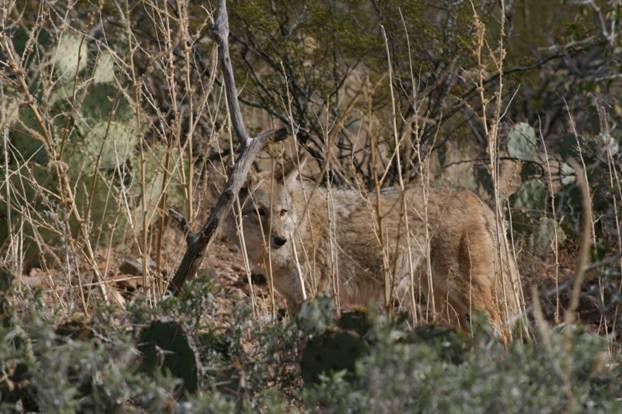
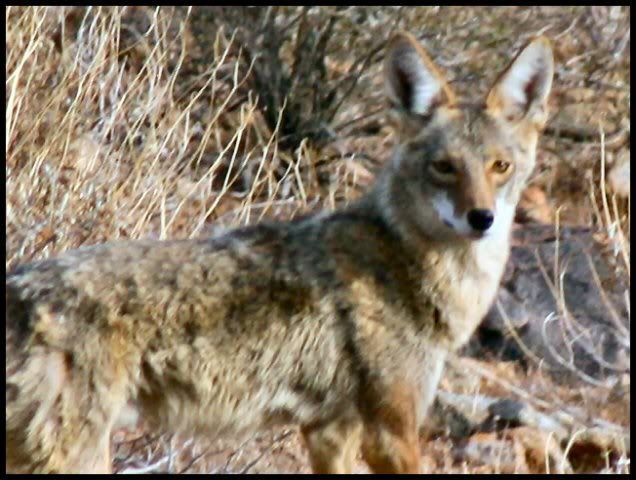
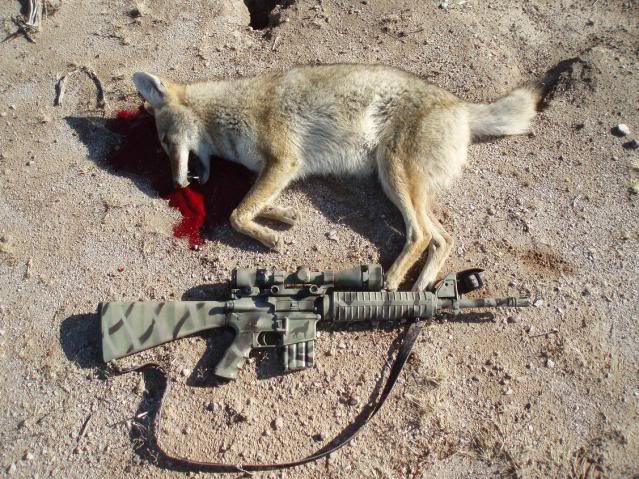
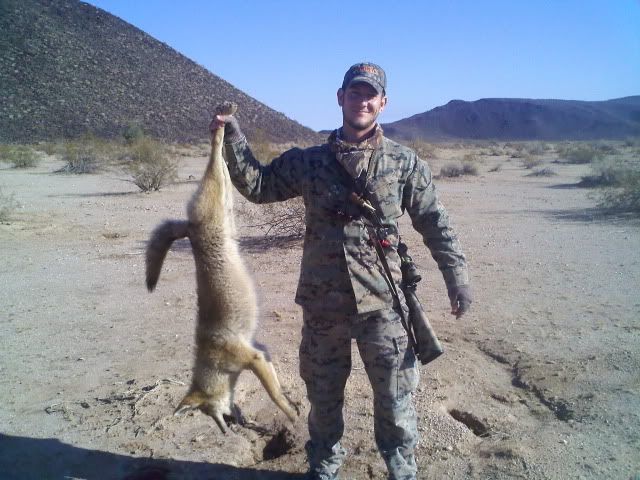
This little ol' male sure gave the fox a scare this morning - no wonder, as a large grey fox in Arizona is anything over 10lbs, while a small coyote is considered anything under 20lbs.

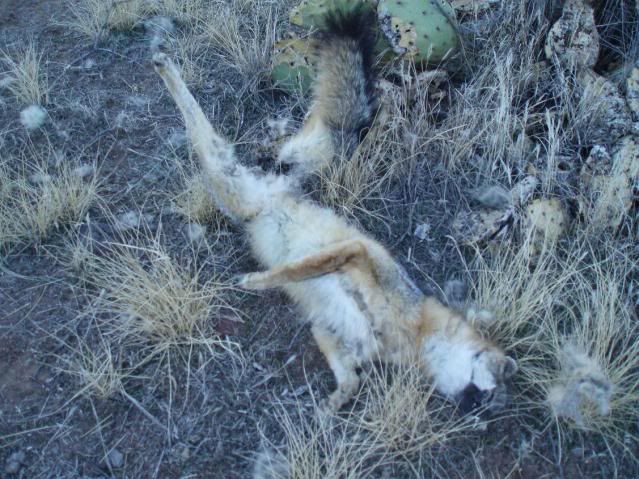
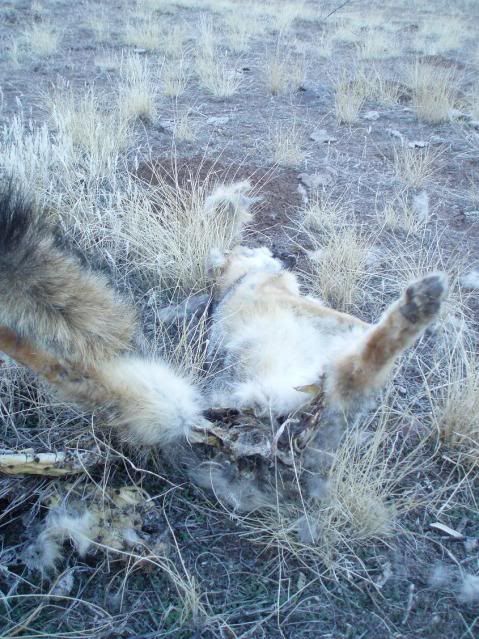
My hunting partner and I found this fox in the middle of a field a couple of weeks ago. The rear-end was eaten out, which is a signature move of the coyote, and there were tons of hair and paw marks all around him. Here's one fox that won't have to worry about anything anymore.
Thursday, January 14, 2010

Shooting predators . . . . with a camera?

The sun was burning high overhead as I settled into another calling stand. The wind was hardly blowing and my setup seemed perfect - plenty of cover, a good view of the terrain, and lots of predator tracks in the area. I began my set with some low and slow lip squeaks. After a few minutes I started in with my LeMarr Tweaked Squirrel, not too loud but nice and raspy. Just a couple of minutes into it I see movement in the brush line about 40 yards out. I keep calling, but the movement stops. Then it reappears, 10 yards down the brushline. My favorite decoy, the feather on a stick, is twirling gently in the breeze just a few feet to my right, and whatever is in the brush is fixated on it. I stop calling completely and a few seconds later the front torso of a bobcat emerges from the brush. He stares at the decoy as he slowly goes into a crouch. He takes one, then two steps forward. Summertime does not leave bobcats will a thick coat, but the spots really show through and this cat is beautiful! He takes another step, then another as he slinks through the tall summer grass, just a few yards now from the decoy - and me! Suddenly he stops as he notices that something's not quite natural about the blob next to the decoy, and he stands straight up and slowly retreats back to the brushline, keeping a watchful eye on the blob. He moves into the brushline, and out of my sight, to keep watch, but I was happy to have seen him so close.

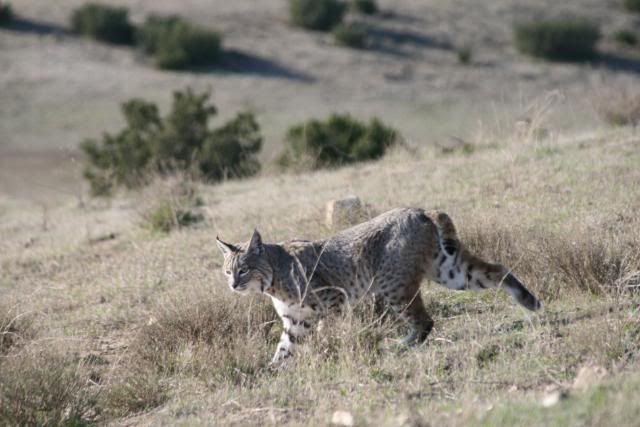
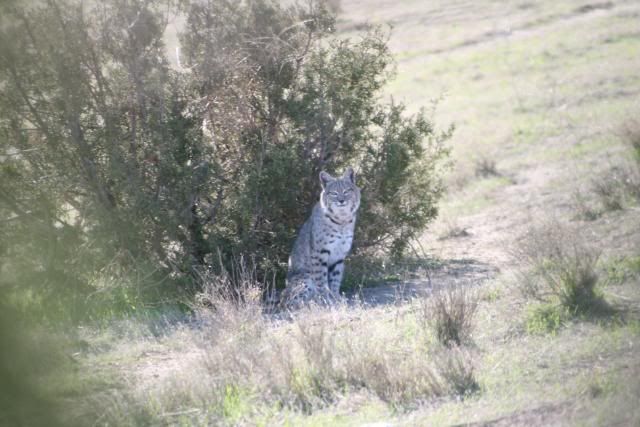
It was summertime two years ago, and I was out doing some pre-season scouting and calling when I got an up close and personal visit from this bobcat - one of my favorite predators. I have unfortunately never gotten into the art of animal photography, otherwise I could better preserve memories like that bobcat for everyone to see. However there are plenty of my fellow predator hunters who have taken their skills as hunters and applied them to photography. Watching animals approach the call, or seeing animals in their natural habitat, is often just as exciting as watching them hit the ground after a well-placed shot. Here's a few of my favorite pictures from some of my friends and fellow hunters.

My friend Scott is not just a good hunter, but is also great with his camera.


Bob caught this bobcat on film recently as it came into stand, circled his caller, and then retreated to the shade to see how things unfolded.


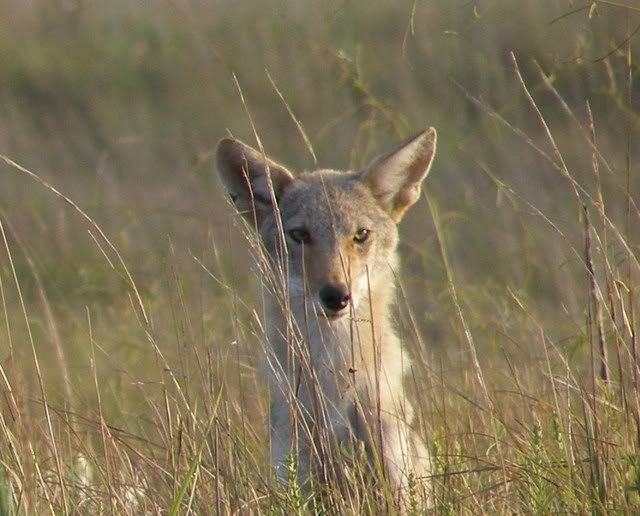
John got this picture of a young summer pup 'keeping an eye out' from the long grass.


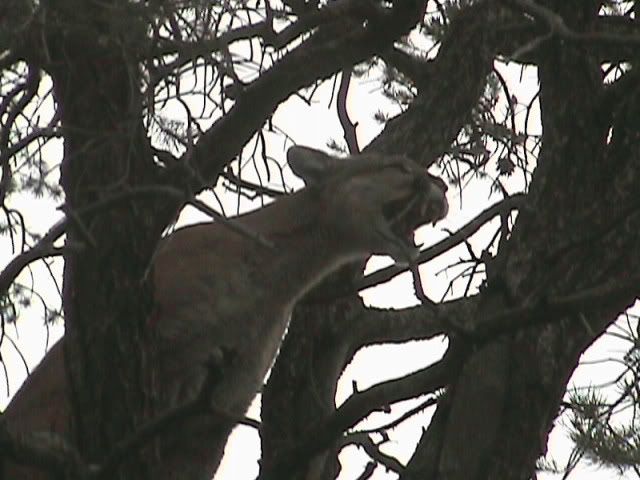
When his well-trained hounds treed this lion, Travis was able to get a few good shots in with his camera while the big cat protested.


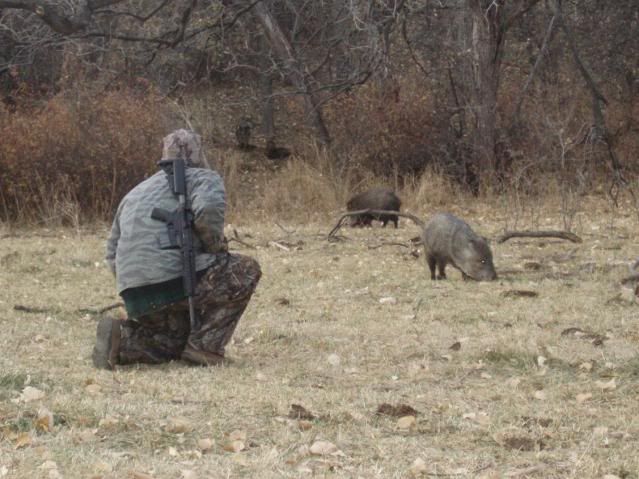
They may not be predators, but when Eric and I were headed to a stand we just couldn't help but get as close as possible to these javelina.

Tuesday, January 5, 2010

Shoot / Don't Shoot

When I was 11 years old I took a Hunter Education Course here in Arizona - and that is something I recommend that every hunter do, even if they are older or more experienced hunters. We watched a video called "Shoot / Don't Shoot" in which they showed various hunting scenes, like bucks on hilltops or elk in ravines, and then we had to decide whether it was safe to shoot or not. The lessons that I learned that night, which have been added to with experience in the field, have helped me many times as I've had to decide between shooting an animal or waiting for a safer shot. A predator stand I did this last week really made me think about the importance of safe shooting, especially when you're hunting with a partner.

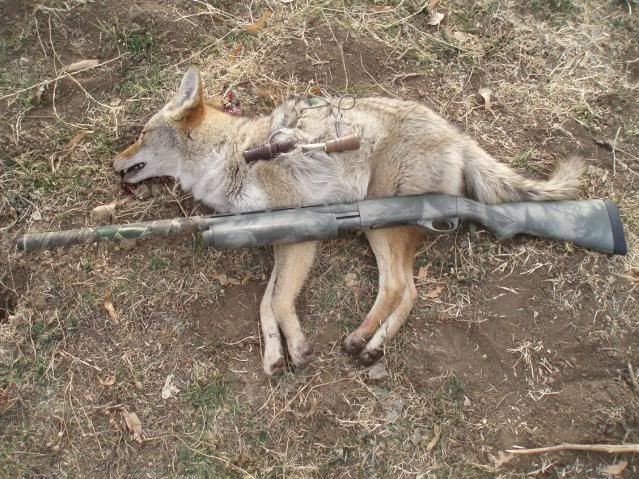
I had some time Wednesday morning for a few stands, and my Dad decided that he'd like to go with me. On our second stand of the day we setup in a small field which was bordered by a creek. I set up with my Dad downwind of me, hoping he would get a shot at anything coming in. At around 8 minutes, a coyote comes in from my left, trots to about 20 yards from me, gets a good look at the decoy I had setup next to me but was totally unaware of me just a few feet away. The coyote starts to lateral in front of me to get a sniff downwind. I saw my Dad shift to get a shot, but when the dog stopped to look at the decoy again, it was directly between my Dad and I. Now I know there are some guys out there that may have gotten excited and tried for this shot, but a miss on either my part or my Dad's could have ended with one of us in the hospital, or worse. The coyote was totally fluid and comfortable, so I didn't rush anything and she was completely unaware of my Dad. She started trotting downwind again, and got clear of a crossfire situation. I hesitated for just a minute as that video from years ago came to my mind - one scene in particular: two guys are quail hunting, but lose sight of one another. One of them flushes quail and starts shooting them, only to discover that he had shot his friend who was behind the quail in the bushes. I consider the fact that I am using a shotgun and that the spread may extend beyond the coyote and towards my Dad. The coyote is now really close to me, and I knew my Dad wouldn't shoot that close to me. I shift my position so that my pattern will be safely beyond my Dad, and I help that coyote avoid the cold winter.

This stand ended well with a coyote down, some up close action, and both of us happy. It ended this way because we were both aware of where the other guy was, which is really important when you're completely hidden in camo and the adrenaline starts to pump. So remember to be safe - a coyote, bobcat, deer, or trophy elk is not worth the life of another human being.

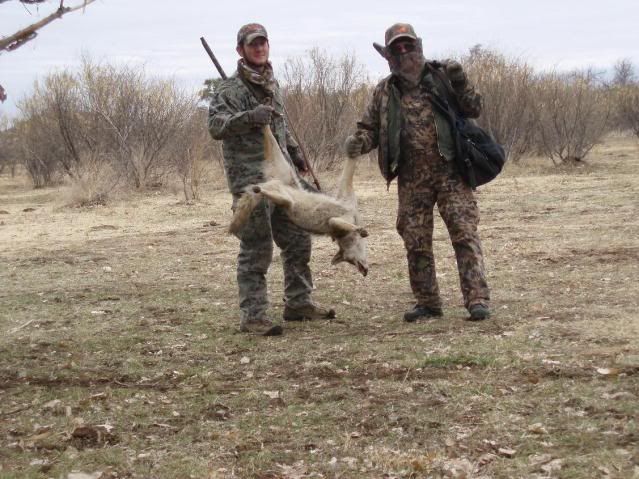
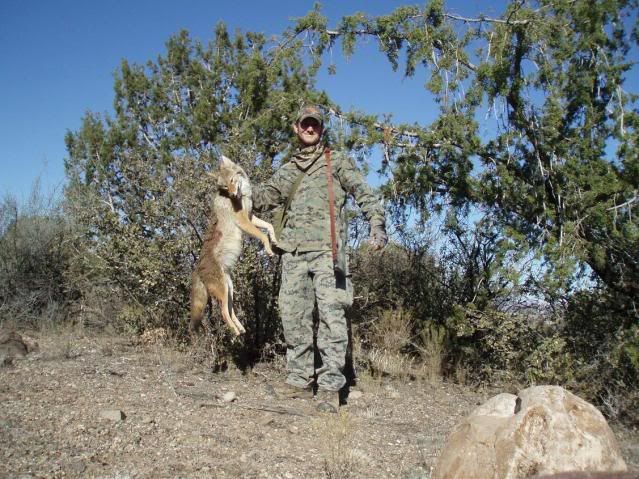
My Dad really knows how to get dressed up for a picture.


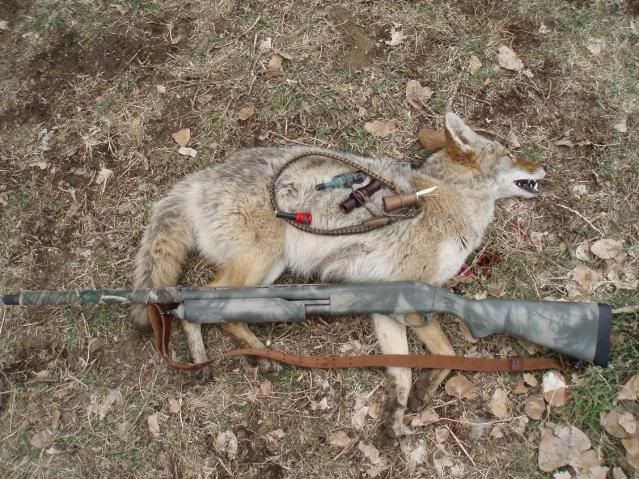
This was my first coyote while using my new call lanyard from Daniel Harmon, and I liked it very much!

Wednesday, December 23, 2009

There's always time for one more stand!

It's been cold and windy and snowy here the last few days, and that means that predators will be hungry when the storm breaks. Well it broke early this morning and I knew that meant it was time to hunt. I headed out to try some local spots, but at my first stand the wind was still blowing so hard it blew my hat off and nearly froze my fingers, so I packed it up and headed a bit farther south. It was a bit of a drive but I knew if I was going to beat the wind I needed to get to a different weather zone, and upon arrival at my new location I was glad I had committed to the travel time. There was no wind and the air was a few degrees warmer.

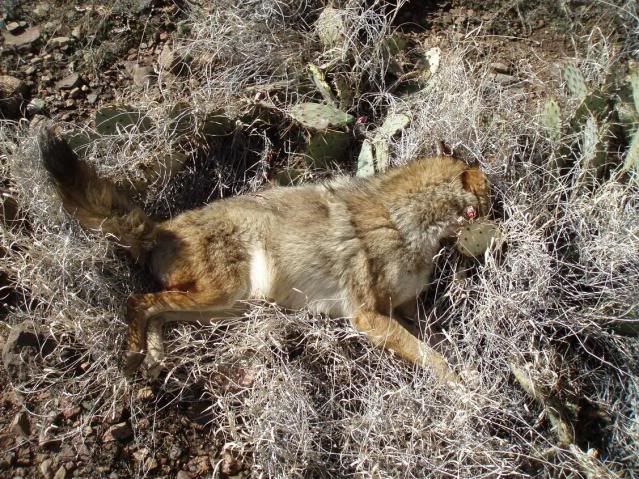
It turned out that someone must have come by just before me and killed all the coyotes, though. I hiked far back into washes and thick brush, but three stands produced no fur, and my free time was running short, so I jumped back in the truck and headed home. As I neared the freeway, I noticed a small canyon that was tucked out of the way and in some thicker brush. Part of me wanted to continue the drive home, but the better part of me (the part that almost always wins) said "there's always time for one more stand!" It would be pushing my time constraints, but I threw caution to the wind, parked in a small turnout, and headed out into the cedars. Right away I knew it would be good, as I nearly tripped over coyote scat when I got out of the truck. I walked about 1/4 mile back into the brush, near the base of small mountain, and set up the stand. I started it off with some low and raspy fox distress, and about four minutes in this coyote comes busting into the open, standing directly in my downwind and getting a nose full of rizzo, to be sure. I knew I didn't have much time, and he looked like he saw me just as I raised the shotgun and settled the barrel over him. But it was too late to run as a load of #4 buckshot found its mark. The yote gave a loud 'yip' as it fell, no, more like nosedived right into some prickly pear cactus.


He had quite a few needles in him, but I couldn't just leave him there so I pulled him out, and while I was at it I grabbed a hero shot.


So remember: even if things aren't cooperating, even when you're thinking of going home - there's always time for one more stand!

Wednesday, December 16, 2009

My handcalling sounds are now available as MP3s

One of the questions I get asked the most about predator hunting is "what sounds should I use and how do I make them sound different than everyone else?" Since I do most of my predator calling using mouth blown hand calls, it is much easier to replicate different sounds on stand, even with the same call. With some practice and some field time, you can figure out how to make different sounds with even the most common handcall, but sometimes it's hard to explain what they should sound like. I decided that it might help if I recorded my calling sounds and turn them into MP3s. Now everyone can hear what sounds I use, and you can also download them for use in your digital caller.

To download a sound, right-click on the link of the sound you want, choose "Save Target As", and then choose a location to save to.

The sounds can be found on the right hand side of my blog, under the "Blog Archive", in the section titled "Hand Call MP3s". The type of sound I am producing is listed first, and then the call and manufacturer are listed. That same info is also imbedded in the file, so it should be displayed when you play the sound. I will add more diverse sounds in the future, especially if I get comments or emails from anyone asking for more.

Enjoy the sounds, and happy hunting!

Wednesday, December 9, 2009

A fox and my 6-year-old son

A friend of mine named Tim recently wrote on Predator Masters about some hunting he did with his 9-year-old daughter. After reading about it, it occurred to me that I haven't taken my son, Garret, out on stand with me yet this season. He often goes shooting and hiking with me, and anyone who has read my book will remember him well.

Tonight we made plans for a couple of stands out on a local rancher's land. My son was so excited to be back in his hunting gear, and he trudged through the mud like a real trooper. Our first stand we set up near a wash and tucked ourselves into some cat claw brush. I let him do most of the calling, but nothing showed up. We headed to the next stand, which was all uphill, but he never complained - it must have been a little tough on him because I got a bit short-winded! We nestled into the base of a cedar tree and I started in on some high-pitched distress. The sun was starting to set, but about 6 minutes into the stand Garret taps my leg, just like I told him to do if he sees something. I look to where he's looking and there stands a grey fox, looking in our direction but not alerted. I raise my shotgun, the only gun I had brought, and realize that this fox is a little too far away. He starts to run downwind and I get a little excited about dropping this fox with my son on stand with me. I squeeze the trigger and BOOM! I think I shot over him! He turns and heads out and BOOM! I let another one rip, but he's already back in the brush. Normally I'd keep calling but instead I turn to Garret and say "You saw that little fox, right?" He's got this huge grin on his face, and then as only my own son could do, he starts to give me a hard time about missing. We walk over to where the fox was and Garret says "I thought it was a squirrel!" We pace off the shot and it turns out it was a little far indeed - 70 yards! Guess Dad got a little "fox fever" and shot too soon. As we headed back to the truck, I watched my son walk through the wild outdoors, and as the world let a beautiful sunset crest the horizon, I knew that life is good.

And we've already made plans to go back after that fox next week!

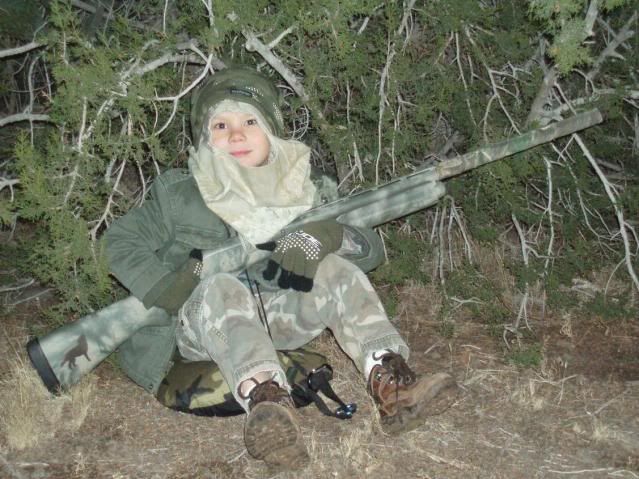
Before we packed it up, I took a picture of Garret on stand. He really wanted to hold my shotgun . . . .

The Copper Cat

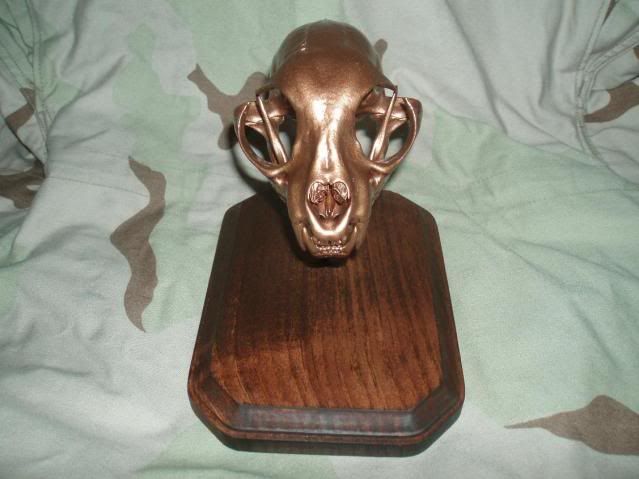
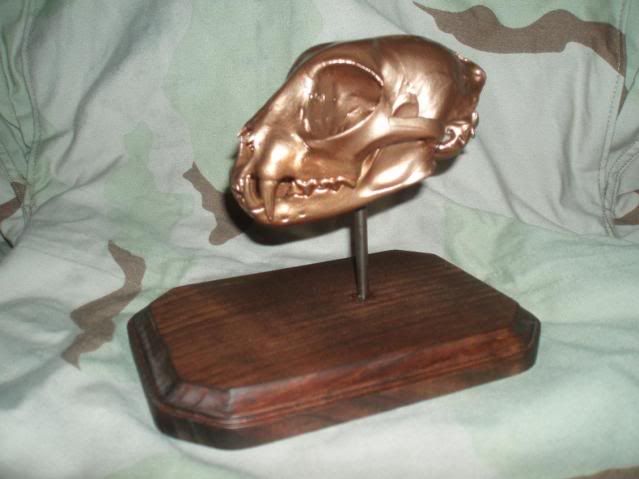
I decided to try something a little new with my skull cleaning. I took a bobcat skull, sprayed it with some primer and then did three coats of hammered copper paint. I then took a wood plaque and stained it with a walnut color. Next I got a small 1/4 threaded steel rod and painted it dark brown, then clear coated it for some shine. Put them all together and I ended up with this:


I think it looks very different! Not really my favorite, but I'm glad I did the project. I donated the whole setup to the Xtreme Predator Callers (XPC) here in Arizona for their Chirstmas party silent auction. I don't know how much it ended up going for, but the guy who won was very happy, so that's what matters!

Sunday, November 29, 2009

Trust Your Gut!

I traveled with my family up to Colorado for the Thanksgiving holiday. It was a really fun trip and we got to see family and friends and have some great adventures. And of course, I couldn't make a trip like that without doing a little hunting! I went out with my brother-in-law Matt and a local friend named Brandon.

Most of the land in Colorado is privately owned, which is such a different experience for me since Arizona is about 85% public. Except for a few stands that we did in the snow covered mountains, most of our hunting was done in the grasslands, and you can see for miles. Of course that means the coyotes can see you from a ways off, as well! Most of the yotes we saw were while we headed to a stand or after we were done, as there is little to no cover. The good news about this type of country is that there are prairie dogs everywhere and in between stands we really enjoyed testing our marksmanship skills on them!

On one small patch of farmland we hunkered down in a little wash with a few very small trees to use as cover. I had thought before we left the truck that I should have brought my shotgun, but this land was so open so I stuck to my rifle. GUT WARNING #1. Matt setup to my right and Brandon to my left, and as I set up my position, I thought to myself that I needed to be able to cover the big field behind me. But that would put me out of cover and in some long grass, so I stuck to the trees. GUT WARNING #2. As I began my calling I really started to look at the terrain features and realized that one of the most likely places a coyote would come from would be into the field behind me, but I hoped that it would have to come by one of my partners first. GUT WARNING #3. A few minutes into the stand I got this strong urge to unhook my sling so that if needed I could shoot my rifle weak-handed and be able to get a shot at something coming in from behind me. GUT WARNING #4. A few more minutes passed as I sang out a rodent distress sound and I realized that all I would have to do is adjust my position a little to be able to get a shot at the field behind me, which now was consuming all of my attention. GUT WARNING #5. Well it turns out there are only so many warnings that your gut instinct will give you, and as the coyote came blazing into the stand to Matt's right and straight to me, I realized that I was out of options. That furred up Colorado coyote stopped at about 30 yards and looked right in my direction as I was trying to figure out how to draw on him since I would have to completely turn my body. I could see from his behavior that the gig was up so I made my move. But I had a lot of movement to pull off and that yote had other ideas. By the time I got my scope on him he was headed for Kansas at Mach 2. I tried to slow him with a bark, then tried to stop him cold with the rifle, but he lived on for another day.

Moral of the story? Whether you are just getting started or whether you've been on countless stands as I have, always trust your gut!

The vistas were beautiful but the terrain is much more open than I am used to.


When we ventured into the high snowy country we came upon some moose, and I was able to sneak pretty close (but not too close!) to this cow and her calf. They are big animals!

Friday, November 20, 2009

The Finishing Shot

I consider myself a good shot. And I practice shooting a lot - I practice on moving targets, close targets and far away targets. It keeps me fine-tuned for shooting in the field when every round counts, and where you may only get one chance. Tuesday morning found me looking through the scope at a nice adult coyote, and just as I pulled the trigger the coyote turned to run, and the bullet made him stumble. I quickly shot again, and I heard the bullet hit but I was worried the dog would get away so I hurried over to where he was. From what I could tell the first bullet hit him in the spine above his shoulders, and the second bullet hit him too far back, shattering one rear leg and breaking the other. He was crippled from the spine shot at any rate, and as I approached he was dragging himself away on his front legs. I really do not like wounding an animal, and I pulled out my pistol to shoot the dog in the head. At first I missed the moving coyote, but I hit him with a subsequent round and he went down.

As I stood near the coyote and thought about the stand, it suddenly raised its head and looked around! I quickly shot it again with the pistol, and this time it was down for good. My point to this story is that when you wound an animal, then you are responsible for giving it a clean and quick death. I took more shots at this coyote than I usually have to, and things got a little bloodier than normal, and maybe it was just one tough dog, but either way I wish I would've killed it quicker. A coyote down is a coyote down, but just remember that amidst all the adrenaline and excitement of hunting, we all need to be as ethical as possible.


Wednesday, November 4, 2009

Eating predators - tasty or not so tasty?

A couple of years ago, I ate a coyote steak - it was nasty. Then I ate a bobcat steak, and it was really tasty. Well today I ate some fox filets, and it was . . . . well you'll need to check out my write-up over at the NPHA called "Predators are tasty!" to find out!

There are some people who are against predator hunting because predators hunters don't eat what we kill. Well I do, so that argument is no longer valid!